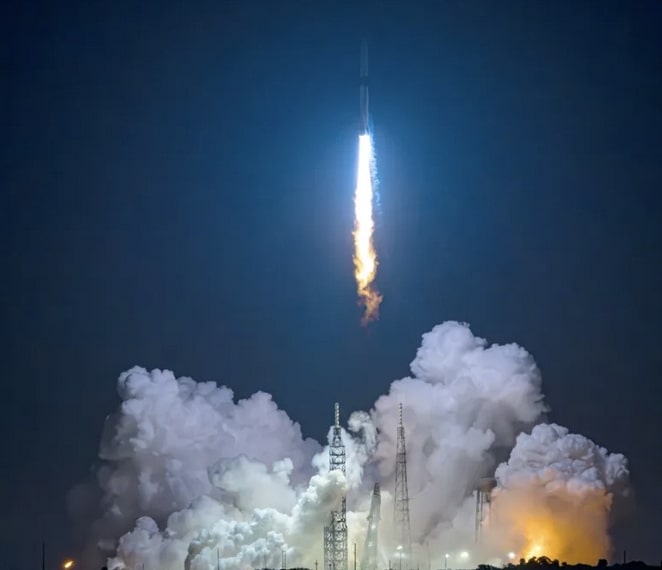
Blue Origin has a critical next flight in November for New Glenn. It will determine if they have a chance for 4 flights in 2026 or 8. They have to be able to cleanly fly and land the booster stage. This will determine if they can reuse the booster every 6 months. Any flight problems will lead to an FAA investigation that will delay third launch by 3-6 months. Here we go over the engine production rate.
Blue Origin is scaling BE-4 manufacturing aggressively at their Huntsville, AL facility to support New Glenn and ULA’s Vulcan. The current production rate is ~50 engines per year and will ramp to 100-150 by late 2026. This supports ~7-14 New Glenn boosters annually at full tilt plus Vulcan’s 2 per flight.
If they cannot land and reuse boosters and have clean flights in November and then all launches in 2026, then there is very low chance that they will get a NASA $2 billion restart of their lunar landing program. The Lunar landing program will add 5 more challenging launches with at least unmanned missions to the moon. If they are still showing problems getting beyond 2-4 launches per year, then you could not add 5 launches and expect to do them in a timely gasion.
Booster (First Stage): Powered by 7 BE-4 engines. Each BE-4 delivers ~550,000 lbf (2,450 kN) of sea-level thrust using oxygen-rich staged combustio
Upper Stage (Second Stage): Powered by 2 BE-3U engines. These are vacuum-optimized variants of the BE-3 (from New Shepard), each producing 175,000 lbf (778 kN) of vacuum thrust.
If there are problems landing the booster, there could end up being modifications to the engines which would slow the production ramp.
BE-3U production is tied to the upper stage builds. Two are used for each upper stage. Blue has completed 8 upper stages as of mid-2025, implying a cadence of 10-20 engines/year soon.
They are building a fleet of 10+ boosters and matching uppers to enable rapid reuse iteration, but delays in certification have historically bottlenecked output.
New Glenn’s maiden flight was in January 2025 delayed from 2020 targets due to BE-4 development hurdles and supply chain issues. The booster recovery—a key reusability goal—failed. The 70-meter-tall first stage executed a boost-back burn using 3-4 BE-4s to target the Atlantic landing barge Jacklyn (10 km downrange). It reached the reentry interface (100 km altitude) intact, with heat shield tiles and grid fins deploying as planned. But during the final landing burn (1 km altitude), the engines failed to relight. There was a problem with slosh-induced oxidizer shortfall in the turbopumps. The booster tumbled, hit the water at ~10-15 m/s, and was lost—creating a debris field but no environmental hazards.
The upcoming second flight (NG-2, NET November 2025 with NASA’s ESCAPADE Mars probes). There is an estimated 70-85% success for landing the stage. The first flight provided invaluable data and ~90% of the recovery profile (ascent, separation, boost-back, reentry) worked. Blue’s fixes include enhanced propellant settling burns, redundant ignition sequences, and AI-augmented fault detection—drawing from 1,000+ BE-4 hot-fires. The sub-orbital New Shepard has had 50+ landings. Weather/sea state remains a ~10-15% abort factor.
If landed, there is 60-75% chance of quick refurb and reflight within 3-6 months. Inspection will focus on heat shield integrity turbopump wear and avionics. Blue’s design minimizes refurb.
A soft failure ( minor charring) enables reuse but hard damage (saltwater corrosion) grounds it for 6-12 months.
The odds are that a booster or launch problem in 2026 or with the November launch could cause delays but there would be more delays with a November problem. I would project 4 launches in 2026 with a good November launch and 8 in 2026. In 2027, they want to get up to 12-24 launches but I think 10-12 is more realistic. The Blue Origin Goal is 50 launches in 2030.
Brian Wang is a Futurist Thought Leader and a popular Science blogger with 1 million readers per month. His blog Nextbigfuture.com is ranked #1 Science News Blog. It covers many disruptive technology and trends including Space, Robotics, Artificial Intelligence, Medicine, Anti-aging Biotechnology, and Nanotechnology.
Known for identifying cutting edge technologies, he is currently a Co-Founder of a startup and fundraiser for high potential early-stage companies. He is the Head of Research for Allocations for deep technology investments and an Angel Investor at Space Angels.
A frequent speaker at corporations, he has been a TEDx speaker, a Singularity University speaker and guest at numerous interviews for radio and podcasts. He is open to public speaking and advising engagements.