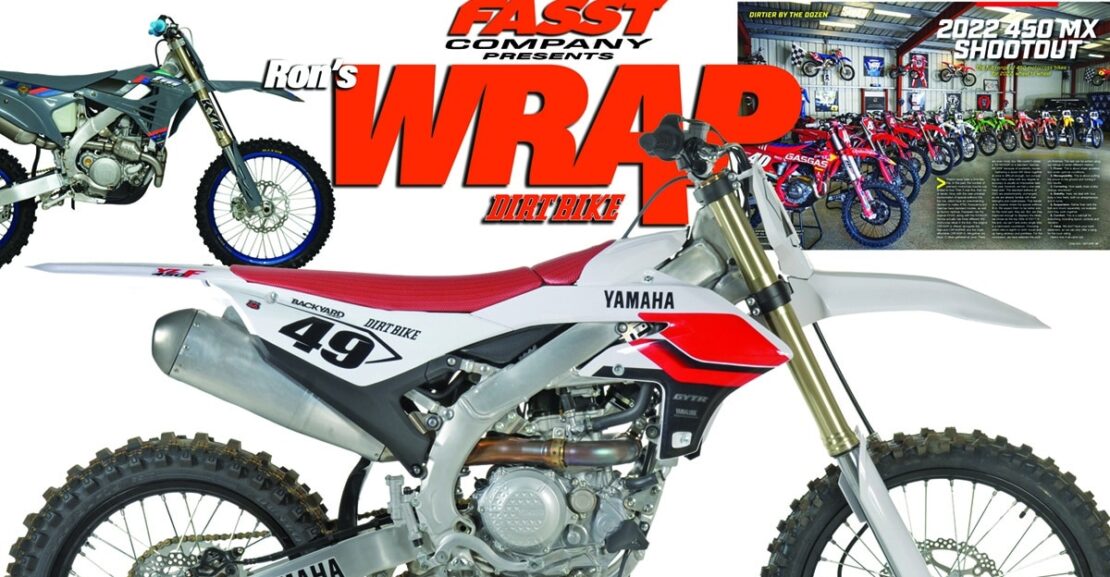
It looks like we’re starting on a 12-bike 450 motocross shootout next month. If you think that’s impossible to accomplish in one day, you’re right. That’s why we don’t do it in one day. We’ve never done a shootout in one day. Sometimes it takes over a year, which is the case here. The Honda, KTM, Kawasaki, Suzuki, GasGas and Husqvarna are unchanged since our last 450 shootout. We have already tested the Kove, the Beta and the Triumph. The Ducati and TM will be the the only untested bikes, and we will spend time with them individually. It’s still a very difficult task, but with a week or so of riding, we should be able to sort them all out. Our most recent 450 test involved the partially new Yamaha YZ450F. Here’s a quick review of what we found with that bike.
YAMAHA YZ450 AT A GLANCE
The 2026 YZ450F isn’t a complete redesign, not like 2023. Instead, the engineers focused on fixing the issues that critics had called out. Job one was making the front end feel more stable and planted. Toward that end, the forged section of the frame downtube was redesigned for more lateral rigidity. At the same time, the engine cradle was made less rigid and the thickness of the engine hangars was altered. The top rear shock mount was also reconfigured to reduce vertical rigidity. The rear shock itself was redesigned with a new base valve structure and the fork got new settings.
As for the motor, Yamaha engineers faced the eternal dilemma: which way to go? No one was asking for more power, so Yamaha’s goal was to have a standard power delivery that suits as many riders as possible without turning to the Power Tuner smartphone app. Toward that end, a new cam was developed as well as a different intake port shape. Flywheel inertia was increased by 8 percent, a resonator was added to the head pipe and the muffler was redesigned. Along the way, the bike’s noise level was reduced substantially–both from a drive-by perspective and from the rider’s vantage point. To top it all off, a hydraulic clutch is standard equipment for 2026. This is another feature for the average guy. Eli Tomac famously preferred a cable clutch–but that’s Eli Tomac. Rank and file riders in the sportsman ranks generally like hydraulic actuation. Interestingly enough, Yamaha previously offered a Brembo hydraulic clutch as an accessory. Now it’s by Nissin.
Back in 2023, all the changes seemed to be directed toward Supercross. The bike was more responsive but less stable. Now, without altering overall geometry, Yamaha has given the bike a much more planted feel. When you enter turns, the front end is less nervous–it seems like the dirt magically got a little tackier everywhere you ride. We can’t really say if it lost anything in that transaction; from our perspective, the changes in frame rigidity seem like a win/win scenario. In the big picture, the Yamaha still feels like a Yamaha. It still likes to slide around flat turns more than steer though ruts. The overall suspension set up also seems very traditional Yamaha. It’s a little stiff, but well balanced with excellent hold up. On moderately rough tracks it seems okay; nothing special. Seniors and beginners might not think it’s the most plush ride in the world, but they generally find a setting that works. At high speeds on the roughest tracks, on the other hand, the YZ450F is exceptional. It all pays off when you find yourself airborne over a sea of calamity, bracing for impact. On the Yamaha, that impact is never that bad.
The 2026 Yamaha YZ450F is still a very, very powerful motorcycle. It hits hard, pulls long and goes fast. It’s just that the previous version was even more of a beast. When you ride it back to back with the 2025 model you realize that the new motor starts making power earlier and is slightly softer on top. It also has a broader peak, meaning you don’t have to shift as often. In addition to increasing low-end torque, Yamaha geared the bike lower. The rear sprocket was a 49, now it’s a 51. Coming in, we knew that the 2026 Yamaha YZ450F was going to have a new feel. We didn’t expect it to be this new. The handling, the power and even the sound make it seem like a different bike. There’s a fair chance that the Yamaha faithful won’t be on board with everything; they might not like the clutch, the power delivery or the gearing. But, the suspension and the overall mannerisms are still very YZ. The individual test of the Yamaha YZ450F is in the December, 2025 print edition of Dirt Bike.
TM MOTORCYCLE PRICES
It’s been very difficult to get a fix on motorcycle prices going into 2026. At first, most manufacturers were saying that the new import tariffs would be added on top of the Manufacturers Suggested Retail Price. It turned out that finance companies didn’t like that so virtually all of them had to change prices and eliminate the surcharge (at least visually). TM was one small manufacturer hit especially hard. They start off high because they are virtually hand-made in Italy in very low quantity. The E.U. has a base tariff of 15%, but there are additional taxes on products made of steel and aluminum. In the end, the new bureaucracy is deep and confusing. Here’s the latest list of TMs that will be imported by 71 Motorsports.
TM FOUR-STROKES
MX 250 FI ES – $12,299
MX 300 FI ES – $12,399
MX 450 FI ES – $12,199
EN-X 250 FI ES – $12,499
EN-X 300 FI ES – $12,599
EN-X 450 FI ES – $12,399
EN 250 FI ES – $12,699
EN 300 FI ES – $12,799
EN 450 FI ES – $12,599
SMK 250 FI ES – $13,699
SMK 450 FI ES – $15,799
FT 450 FI ES – $13,099
TM TWO-STROKES
MX 85 Jr – $7,199
MX 85 Jr US Race Edition – $1,000
MX 100 Jr – $7,299
MX 112 Jr – $7,999
MX 125 ES – $9,899
MX 125 FI ES – $9,999
MX 144 – $9,599
MX 250 ES – $10,899
MX 250 ES US Race Edition – $1,000
MX 250 FI ES – $10,999
MX 300 ES – $11,099
MX 300 FI ES – $11,199
EN-X 125 ES – $10,199
EN-X 125 FI ES – $10,299
EN-X 144 – $9,899
EN-X 250 ES – $11,199
EN-X 250 FI ES – $11,299
EN-X 300 ES – $11,499
EN-X 300 FI ES – $11,599
EN 125 ES – $10,699
EN 125 FI ES – $10,699
EN 250 ES – $11,599
EN 250 FI ES – $11,599
EN 300 ES – $11,699
EN 300 FI ES – $11,799
SMX 85 Jr – $7,899
SMX 100 Jr – $7,999
SMX 112 Jr – $8,699
SMX 300 ES – $11,699
FT 300 ES – $11,399
The Corse model is available on most models with an additional price of $1,600.
The 85 and 250 US Race Editions are for the AMA Limited classes. They have upgraded cylinder head, exhaust and front brake, are all white with custom graphics..
A BRIEF HISTORY OF THE UNIVERSE AND DIRT BIKE MAGAZINE
Dirt Bike is the saltwater crocodile of magazines. We’re not pretty, and we should have gone extinct a long time ago.
Dirt Bike started publication in June 1971. It was published by William Golden, who owned Chopper Magazine and Big Bike. Super Hunky (aka Rick Sieman) worked on those publications and talked Golden into starting a magazine all about dirt bikes, which didn’t exist at the time. Rick said he had too much on his plate to be the editor, so a guy named John Huetter was in charge of that first issue. Fun fact: there technically wasn’t a second issue. If you find a copy of the July 1971 issue, it’s from an alternate universe where the first issue was actually good enough to justify another.
Hunky took over after a month of indecision, and since then there have been 651 uninterrupted issues and 11 often interrupted editors. They were a bizarre lot who had absolutely nothing in common aside from a love of dirt bikes. Here are some of the ones I know of.
Rick was a one-man Czechoslovakian tornado. He had an opinion about everything and a flash temper, which was part of his charm. His vision for Dirt Bike was perfect at the time. In 1971, the motorcycle industry was booming with a huge influx of very young riders. People say he wrote the magazine for a 14-year-old. That was no accident. Some of his more memorable stories included a portable toilet shootout titled “Heads, Head-to-Head” and coverage of the 1973 ISDT called “Six Days of Almost Seeing Steve McQueen.” Rick had no trouble throwing the occasional motorcycle to the wolves, including the Honda XL175, which he pictured in a pigpen with the subtitle “At $2.89 a pound, this is expensive pork.” Hunky lost his temper for some forgotten reason and left (for the first time) late in 1974.
For the next few years the editor’s chair at Dirt Bike was sitting on top of a big trapdoor. Gunnar Lindstrom was far and away the most accomplished person to work at DB in any capacity. He had an engineering degree from his native country of Sweden and was a member of the first U.S. Motocross des Nations team in 1971. He engineered such memorable covers as Darth Vader on a Husky Auto and Marty Smith in front of a firetruck. Gunnar left to work in Honda’s technical department in late 1977. Next was Len Weed, who was already an accomplished author and photographer—a real live journalist. He was a die-hard trials enthusiast, which crept its way into the magazine.
Then came Super Hunky, part two. Rick had worked at other titles before deciding that Bill Golden wasn’t such a bad boss after all. He came back in January 1979 and promised to make big changes. He promised that Dirt Bike would never be slow and boring again; a clear shot at Len Weed’s trials fixation. Two of the editors he hired were Paul Clipper and Tom Webb.
Somewhere in that period Roland Hinz entered the picture. He came from the tabloid industry and was originally hired as an adviser. After a short period, he became president of the company, and Bill Golden vanished in retirement. Roland turned the company around financially; it was in serious trouble before he got there. But, he was another man with a temper and an opinion. It was inevitable that Hunky and Roland would clash. In September 1985 Rick left again, reportedly throwing a typewriter out the window before he did. That would have made Paul Clipper the editor, except he quit the month before.
Tom Webb was next up. That was a perfect fit. Tom was the king of the desert enduro at the time, and he was trained in the Super Hunky school of hyperbole. He upped the ante for testing with a higher regard for actual facts. Then, a few years later, he took a job at Dirt Rider, which immediately became Dirt Bike’s most intense competitor.
Ed Arnet was one of the fastest, most talented riders to ever be the editor of any motorcycle magazine. He moved to DB from Motocross Action. There were two things that you had to understand about Ed: first, he worked super hard and expected everyone else to do the same. Second, he was a little crazy. Maybe a lot. At one time he hid in the bushes overnight to get a photo of a new Honda prototype. He was stung by multiple bees in the process and went straight to the hospital afterward. In 1989, Ed crashed in a desert race and was in a coma. He woke up and quit. Later, he would return to the company as editor of Mountain Bike Action, but he was still a little crazy.
For a period of time after Ed’s departure, Tim Tolleson and Joe Kosch worked as interim editors. Then came Super Hunky, part three. Rick decided that Roland Hinz wasn’t so bad and came back as a contributor/adviser. That was where I came in. November 1990 was my issue as editor. I’m not really sure what happened next.
It’s still happening.