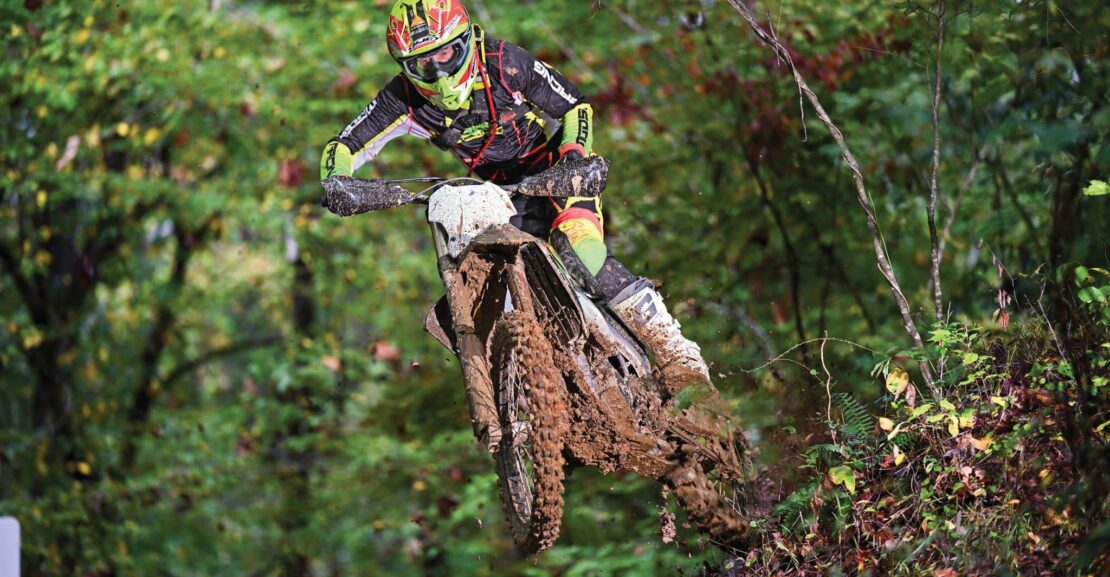
In 2023, the total number of dirt bikes in the Triumph line was zero. Now, with the arrival of the TF450-C and TF250-C, there are six total—and more are stacking up in the pipeline. Today’s off-road universe is divided into multiple groups and subgroups of bikes made for very specific purposes. Triumph is demonstrating that they can play the specialization game as well as anyone.
The new C models are cross-country race bikes that join the X (motocross) and E (enduro) lines. We have to admit that this addition to the Triumph fleet caught us by surprise. When we tested the TF450-E in October, we declared that it would fill the role of cross-country racer for Triumph. That bike was so much more aggressively tuned than other trail bikes like the Honda CRF450X, Yamaha WR450F and KTM 450XC-W, we didn’t foresee an even more race-oriented line. Yet, here we are with the Triumph TF450-C, which is basically a motocross bike set up for GNCC-style racing.
FAMILY TREE
Here’s how the TF450-C fits into the family. It has the same motor, gearbox and frame as the 2026 TF450-X motocross bike. That means it has a single-overhead-cam motor that pushes over 60 horsepower through a five-speed gearbox and uses a full-competition muffler. The only engine-tuning difference is off-road mapping. The chassis is built around the exact same aluminum single-backbone frame as all the other dirt bikes in the Triumph line, but the KYB suspension is tuned for off-road riding (or racing). It has a larger fuel tank than the motocross bike (2.2 gallons versus 1.8), an 18-inch rear wheel, Dunlop AT82 tires, handguards, a skid plate and a kickstand. If that sounds familiar, it should be. KTM, Husqvarna, Honda, GasGas, Yamaha, Kawasaki and Beta all have cross-country race bikes that use more or less the same formula.
To back up a little, the 450-E tested in October has a much longer list of features that separate it from the motocross bike. It has a different head and crankshaft in addition to a six-speed gearbox. That bike, however, is still a closed-course competition bike as defined by the U.S. government. That means it does not have an especially quiet exhaust and is not eligible for a California green sticker. It also means that there’s a great deal of overlap with this new C model.
For 2026, all three of the Triumph 450s got some common updates. A new clutch hub has reconfigured lubrication ports, and a new Belleville clutch spring allows for more consistent engagement. The engine mounts are reconfigured, and a new gearbox selector star is designed to address notchy shifting.
LET’S RIDE TORNADO
Triumph invited us to ride the new TF450-C in the Hatfield-McCoy Trail System of West Virginia, not far from the site of the Mountaineer GNCC. The Hatfield-McCoy Trail System is perhaps more famous in ATV circles, but the West Virginia Trail Authority recently opened a new network specifically for motorcycles called the “Tornado Single Trax.” That’s where we spent a day with the new Triumphs.
Up front, you have to understand that the TF450-C is a race bike first and foremost. It has enough power to line up next to anything in the MX realm and have a reasonable expectation of a holeshot. With that understanding, you can expect the bike to be a beast in the woods. But, as beasts go, the Triumph does have some manners. Our very first experience with last year’s TF450-RC (Ricky Carmichael) Edition was on a muddy red-clay track in Georgia where we learned it had one of the smoothest, sweetest power deliveries in the motocross world.
The conditions on the Tornado Single Trax trails were similar; overnight rainfall left polished clay and extremely slippery conditions. Traction was a struggle in the morning, although it improved throughout the day. The Triumph’s power delivery was smooth enough to make it manageable, although you still had to be very respectful with the throttle. There was nowhere where you could use full power.
Like the other Triumph off-road bikes, the TF450-C has a pod on the left side of the handlebar that offers some help. It has a map switch, as well as buttons for traction control, launch assist and Quickshift. The two maps that are preloaded into the bike’s ECU are standard and a mild map, which has about 10 percent of the bike’s full output shaved off the top. Beyond that, Triumph offers tuning though its own smartphone app. In order to use this, you have to install a connectivity unit. That came as standard equipment on the TF450-RC, but not this bike. Triumph sells it through its accessory division for $210.
Once you have the MX Tune Pro app on your phone, you connect through Wi-Fi to the bike. Yamaha Power Tuner users know the drill. Triumph has five maps precooked and ready to upload into the bike’s ECU: OE Factory, Desert, Fast Woods, Single Track and Soft. OE Factory has zeros across the table for both fuel and spark advance. Desert is a little tangier, with mostly positive figures across the chart, meaning more fuel and more advance. Soft has mostly negative numbers. With the slick conditions, we loaded up the soft maps and piggybacked that with traction control. That tamed down the hit considerably.
But, don’t expect miracles. You can only do so much through electronic means; you can’t decrease compression or change cam lift. No matter how many negative numbers you install, a TF450-C is never going to be a fluffy trail bike. You will always have to deal with a boatload of power, you always have to beware of stalling, and you always have to cover the clutch.
ROOTS, ROCKS & RUTS
Motocross suspension tuners have it easy compared to off-road guys. MX tracks only vary by so much, whereas “off-road” can mean anything from Baja to EnduroCross. Triumph at least had a general target of GNCC racing in mind. That means the TF450-C is made for very rough conditions and moderate speeds. The conditions we faced at Tornado Single Trax were far, far smoother than any GNCC course this year. The bike should have been a little on the stiff side, and it was. But, it was still comfortable. In fact, the true test of any good off-road setup is versatility. The same race can have miles of first-gear rock gardens, as well as a motocross-style grass track. West Virginia gave us a little glimpse of that kind of variation, and the TF450-C handled it all without issue. At last, part of the credit has to go to the frame. Right from the start of Triumph’s venture into the dirt world, good handling has always been a common theme from bike to bike. We loved the way the original TF250-X handled, and we have loved every Triumph since then. The TF450-C feels light and easy to toss around, it’s stable, and it turns well. You can’t ask for much more.
TRIUMPH TF250-C
We briefly got to ride the 250cc version of the same bike. It kinda stole the show. In wet, slick conditions, the milder power output of the 250 was actually an advantage. Plus, the 250’s crazy ability to rev gave it an absurdly wide power range. It makes enough torque to idle though ruts and roots, then when conditions open up, you can rev it to over 13,000 rpm. Essentially, you never have to shift. There’s also the often-repeated factor about perceived weight. A 250 might weigh about 3 pounds less than a 450 on the scale, but it feels far, far lighter on the trail. Part of that is physics. The heavier crank of a big motor creates more gyro effect and therefore wants to hold its place in space to a greater degree. More than that, a 250 is simply less tiring. Look no further than the results of this year’s GNCC Pro classes. The 250s are routinely beating the 450.
WHERE TO GO, WHERE TO RACE
The guys at Triumph are very clear on the point that the new C models are designed for GNCC racing. Maybe so, but they might be overlooking more fruitful hunting grounds out west. The NGPC and WORCS venues are natural for bikes with a strong MX heritage and often include long motocross sections. In the tighter, more technical sections that define eastern off-road racing, Triumph’s own E models might be more suited. Either way, it’s hard to believe that this is a first-year effort. We can hardly wait to see what comes next.