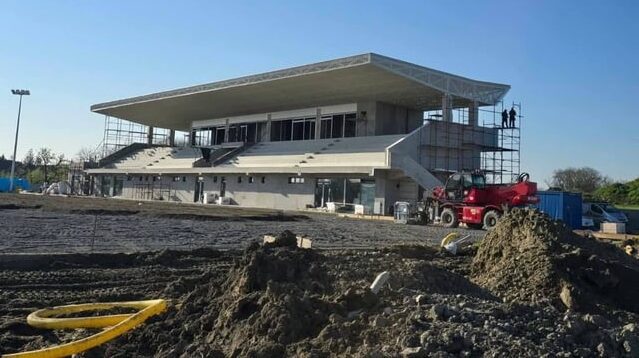
The construction of a 7.5-million-euro stadium in the small Croatian village of Vardarac in the east of the country, home to just 504 residents in 211 households, is again prompting debate about Hungary’s political soft power efforts in neighbouring countries with Hungarian minorities.
Robert Jankovics, a representative of the Hungarian minority in the Croatian parliament, said the football academy was built based on a 2022 interstate agreement between Croatia and Hungary, and that it addresses mutual concerns related to national minorities, initiated by both countries.
“This is explicitly stated in the minutes of the Joint Committee of the Croatian and Hungarian Governments for the Protection of National Minorities,” Jankovics told BIRN, adding that the project has been widely misinterpreted by the media, primarily because the stadium was built in a village of only 500 residents.
“This agreement is reciprocal. For example, the Croatian community in Hungary built the National Theatre in the Hungarian city of Pecs,” said Jankovics, a politician seen close to Hungary’s ruling Fidesz party. He personally attended Prime Minister Viktor Orban’s State of the Nation address last year and surprised Foreign Affairs and Trade Minister Peter Szijjarto with a custom-made Vardarac soccer jersey bearing his name.
Jankovics addressed questions about the cost of the project in Vardarac, pointing out it is not just a stadium but also a football academy – the type of comprehensive project close to Orban’s heart and similar to other ventures across Hungary and in Hungarian communities beyond the country’s borders.
The Hungarian government began financing football academies outside the country’s borders – in regions of the former Kingdom of Hungary with Hungarian minorities – starting in 2013, typically through the Gabor Bethlen Fund. So far, it has funded three football academies in Slovakia, two in Romania, and one each in Croatia, Slovenia, Serbia and Ukraine. While no official figures are available, Hungarian media estimate that at least 30 billion forints (75 million euros) have been spent on these academies and stadiums since 2013.
Construction of the Vardarac project began in 2024 and is expected to be completed by October. The facility will include luxury features such as a fitness room, massage room, sauna and a pool for players.
“The most favourable bidder with the shortest construction deadline was selected,” Jankovics explained, noting the recent surge in construction material and labour prices.
Besides, Jankovics added, “the rental of the stadium in Vinkovci, where the Vukovar 1991 football club will play its matches due to the lack of a suitable stadium, ranges from 800,000 euros to 1 million euros per season.”
He emphasised that the project is not solely about the stadium itself. There are slightly more than 10,000 members of the Hungarian national minority in Croatia, around 8,000 of whom live in the Baranja region, and the new facility is intended as a gathering place for this community.
“It is a football camp for the Hungarian community in Croatia, where children will finally have access to proper training conditions,” Jankovics said.
The NK Vardarac football club has been one of the most successful amateur clubs in eastern Croatia for several years. The club is financially stable, and the team was promoted to the Third Football League last season.
While the Hungarian national minority in Croatia will benefit from a new facility that can serve as a community hub, it is also part of a broader policy of the Hungarian government of Viktor Orban to invest significant funds in sports and cultural infrastructure in the border regions of neighbouring countries where Hungarian minorities live.
The Hungarian media are questioning how the government has once again managed to secure funding for yet another costly foreign investment, even as the country’s economy stagnates, the government was forced to issue new bonds to cover the deficit, and public investment projects in Hungary are largely on hold.
The football-mad Hungarian prime minister has clearly stated in the past his view that such investments are above normal considerations about the use of taxpayer money. “Sport is our common language; it connects us. That’s why the Hungarian government will support the establishment of academies throughout the entire Carpathian Basin,” Orban said in 2018.
Critics note that Orban’s strategy appears designed more to win the votes of the Hungarian disaspora in neighbouring regions. To date, it has been very successful in drumming up support: in 2022, Fidesz received 94 per cent of the votes of Hungarians living beyond the borders, giving it two extra seats in parliament.