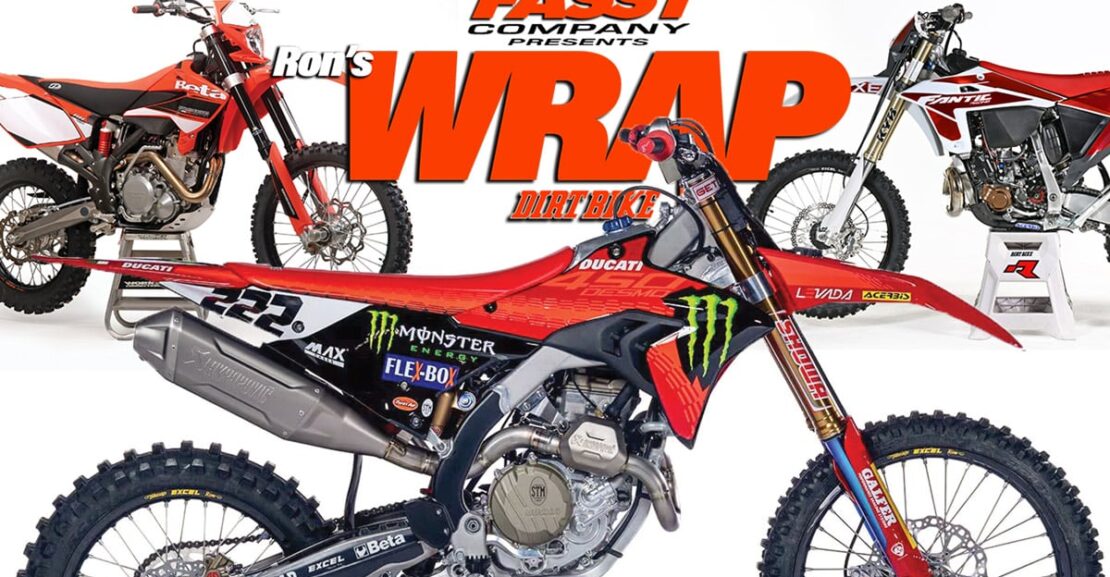
Between Ducati’s entry in the motocross world and Fantic’s arrival in the U.S., it’s become clear: we have to brush up on our Italian. Italy has always been a major player in the dirt bike world, but for various reasons, they haven’t always been imported to the U.S. in very large numbers. In the 54 years that Dirt Bike has been testing motorcycles, there have been dozens of Italian brands that we’ve seen, ridden or just heard rumors of. There are two things they all have in common: First, they are all beautifully crafted. Second, they have very complicated histories full of in-fighting and financial squabbles. Here are some of the more memorable Italian jobs that have appeared in the pages of Dirt Bike.
Between Ducati’s entry in the motocross world and Fantic’s arrival in the U.S., it’s become clear: we have to brush up on our Italian. Italy has always been a major player in the dirt bike world, but for various reasons, they haven’t been imported to the U.S. in very large numbers. In the 54 years that Dirt Bike has been testing motorcycles, there have been dozens of Italian brands that we’ve seen, ridden or just heard rumors of. There are two things they all have in common: First, they are all beautifully crafted. Second, they have very complicated histories full of in-fighting and financial squabbles. Here are some of the more memorable Italian jobs that have appeared in the pages of Dirt Bike.
GET YOUR MOTOR RUNNING
Aermacchi had a very complicated history. This was an Italian aircraft company on the shores of Lake Varese that made Italy’s greatest fighters in WWII. The company started making small-displacement two-strokes after the war and was eventually bought by AMF Harley-Davidson. The thinking was that it would help Harley compete against the Japanese bikes of the day. The Harley Baja 100 was most famous for giving Larry Roeseler his start. In stock form, it wasn’t that great. Dirt Bike Magazine called it “a re-hashed Italian street bike with no redeeming traits.”
THE MOTOR COMPANY
For a short time, Harley-Davidson was deeply involved in off-road racing. Larry Roeseler, Bruce Oglivie and Bob Rutton won several desert races, including the Baja 500. In motocross, Marty Tripes and Rex Staten rode for the factory Harley team. The 1978 Harley-Davidson MX250 was a one-year model that came out of the Aermacchi factory before the Italian Harley chapter ended.
FAMILY FIRST
Claudio and Gianfranco Castiglioni had a massive effect on the motorcycle industry that is still felt today. In the ’80s, they acquired the Aermacchi/Harley Davidson factory in Varese and started their own brand. They named it Cagiva as a composite of their family name and the town of Varese. In 1987 they acquired Husqvarna. Shortly afterward they also took control of Ducati and MV Agusta. The company always seemed to struggle, but bounced back from disaster time after time.
BIRTH OF A GENRE
Italjet is a scooter company that was a pioneer in the mini-cycle world. Many famous motocross riders of the ’90s got their start racing Italjet two-strokes. Today, Italjet still makes scooters, but clearly inspired companies like Cobra.
A NAME THAT LIVES ON
SWM was a company in Milan that had considerable success in trials and off-road racing. The original company ceased production in 1984, but was resurrected 30 years later with financial backing from Chinese conglomerate Shinray. Today, some SWM motorcycles are manufactured at the former Husqvarna factory near Varese, while others are made in China.
SOME NAMES JUST DON’T TRANSLATE
Kramer was an Italian motorcycle company that used Austrian Rotax motors in the ’70s. At some point, they were re-branded with the name “Kram-It.” That didn’t play well in English-speaking countries.
THE BOOM WE MISSED
For many years Italy’s biggest motorcycle manufacturer was Aprilia. The company’s mainstay was small-displacement two-stroke street bikes, which were effectively banned in America back in the ’80s.
THE BOOM WE CAUGHT
Aprilia was making adventure bikes before we called them adventure bikes. The 600 Wind was a bike that U.S. riders didn’t understand in 1990. We would eat it up today.
LITTLE GROUND BREAKER
LEM was another Italian company that set the stage for the mini racers of today. They used Franco Morini two-stroke motors and were quite successful in the late ’90s.
AN ITALIAN KTM?
That was how the Austrian company first got involved with minis. KTM decided it was easier to re-badge LEMs than it was to make their own 50cc bikes. The KTM/LEM had spectacular success in U.S. racing with Mike Alessi. By 1996, KTM decided to build its own minis.
PINK POWER
TM Moto goes back to 1977, but didn’t have an official U.S. importer until the ’90s. The company started off in the karting world and transitioned into off-road. Back then, the ISDE had a class for full-size 80cc bikes, and TM dominated the field.
THE HUSKY LEGACY
When Cagiva purchased Husqvarna from Electrolux in 1987, the only model that was retained was the 510cc four-stroke. Over the years that bike evolved, and before long, it had only a hint of the original Swedish design. Overall, the four-stroke was the best motorcycle to carry the Husqvarna name in the ’90s.
LITTLE BUT LATE
By 2000, Husqvarna had joined the crowd of manufacturers that re-badged LEM minis with the Franco Morini motor. At that time Husqvarna had a number of impressive R&D projects in the back room, but was struggling to keep the front door open.
WHAT’S THAT IN YOUR POCKET?
Polini started off making hop-up kits for scooters. Eventually, they started making their own motors, and that led to an explosion of “pocket bikes,” which were miniature GP road racers. In the late ’90s, the company also produced motocross bikes.
V-2 ROCKET
Aprilia’s 500cc, V-twin dual-sport bike was amazingly sophisticated and wicked fast. The bike had potential, but production costs were high and some glitches were never worked out. Very few were imported to the U.S.
THE MX TWIN
In the mid-2000s, Aprilia produced the most sophisticated 450cc motocross bike ever made. The MXV450 was a fuel-injected V-twin that weighed only 245 pounds. In 2010, Josh Choppins finished 12th overall in the MXGP World Championship on the works MXV450. Not long afterward, the project was abandoned.
BETA GOES OFF-ROAD
For years Beta specialized in trials bikes. That changed in the mid-2000s when the first Beta 450RR arrived. At the time Beta purchased its motors from KTM. It was only a few years before Beta produced its own four-stroke motor to become the biggest Italian importer of off-road bikes.
LUCKY EXPLORER
In 1990 and 1994, Edi Orioli won the Dakar Rally on a Cagiva. Or was it a Ducati? Or was it an MV Agusta? All three brands were under the same umbrella in those days. Today, MV Agusta uses that legacy to promote the LXP Orioli Edition.
VERTEMATI PART ONE
Alvaro and Guido Vertemati started off as the Husaberg importer and were quite successful in GP racing with Joel Smets, winning three championships in the ’90s. It was a great bike, but financial issues kept it from reaching production.
VERTEMATI PART TWO
The Vertemati brothers took on partners to bring a compromised production version of their bike to the market in 1999. This one was imported by White Bros.
VERTEMATI PART THREE
Alvaro and Guido Vertemati broke away from the production company they founded, which was relaunched as VOR.
VERTEMATI PART FOUR
The Vertemati brothers finally reached limited production with their own bike in 2001. It was beautifully constructed.
DUAL CITIZENSHIP
Benelli is one of the oldest motorcycle manufacturers in the world. After years of struggle, the company ceased production in 2003 and then was acquired by Qianjiang Motorcycle, a large Chinese company two years later.
DUAL CITIZENSHIP PART TWO
Moto Morini is another iconic Italian brand that goes back almost 100 years. It was once a piece of the Cagiva conglomerate, but now is owned by Zhongneng Vehicle Group. Like Benelli, Morini maintains a design department in Italy.
Ciao!