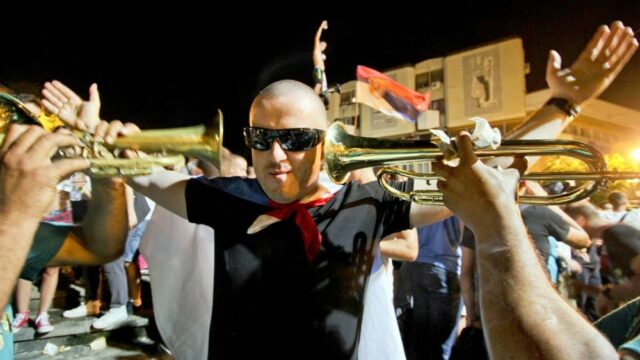
For a while, Balkan folk was “the new punk”, as jarring as this may be for Balkan people, folk people and punk people to hear. “Balkan Beats” began as a dance party in underground clubs in Berlin, and grew into a global phenomenon, filling clubs in multiple cities on multiple continents.
Along the way, a techno-infused variant of Balkan brass music (but not, boze savuvaj, turbo-folk!) became the world’s window into Balkan identity, for better or for worse.
The recently-published Balkan Beats: An Oral History chronicles the rise and fall of the movement through a large number of interviews with participants (the list of interviewees with short bios takes nine pages), all conducted by Robert Soko, the DJ who spearheaded the movement, and Robert Rigney, a music journalist and Balkan Insight contributor who carries the title of “Balkan Beats historian”. The interviews are interspersed with some short texts, some of them analytical and some of them autobiographical, by Soko and Rigney.
I have a couple of critical things to say about this otherwise fascinating and delightful book. Let’s get those out of the way in the beginning so we can move on to the fun stuff. First, the authors acknowledge their debt to Please Kill Me, the classic oral history of the rise of New York punk rock by Gillian McCain and Legs McNeil (in an afterword Rigney identifies some other stylistic influences as well).
Indeed, structurally and in terms of the type of content, it looks a lot like the work that inspired them. This means that it shares many of the strengths (detail, depth) of that book, as well as some of its more befuddling characteristics (facts you probably didn’t want to know, people you were not hoping to hear from). So the reader gets to hear from an eclectic range of interlocutors (myself included), some of whom you would not expect to be there. With Please Kill Me you just found yourself wondering what moved them to talk to Todd Rundgren. It is a little harder in this case, since Rundgren seems like a personable fellow who tells a good story, while Nele Karajlic is just as off-putting as you would expect.
Second, the book mixes its account of the coming together of a range of musical styles and influences and the emergence of a fascinating hybrid culture, a fascinating story in itself, with the autobiographical reflections of several of the protagonists, and these will be interesting mostly to insiders.
But enough critical observations; the book offers plenty of insight and introduces some serious problems in its casual fashion. It offers a slice of the history of the late 20th and early 21st centuries, sheds light on ways in which different cultures come together (and on ways they fail to come together), and as much as it focuses on the light and dark side of partying, raises (and takes seriously!) some important questions in ethnomusicology.
It all started in Germany
Eugene Hutz (right) with Gogol Bordello on stage in Lanuza, Spain, July 2016. Photo: EPA/JAVIER CEBOLLADA
Fundamentally, the book uses the autobiographical reflections of an incendiary celebrity (Soko) and an erudite fan (Rigney) to tell the story of the German dance party that spread from its origins among Balkan migrants in the harsh wildernesses of Teutonia to acquire global resonance and come to be identified with the identity, horror, and romance of the Balkans under the name “Balkan Beats”.
The name itself was coined by the book’s coauthor, Robert Soko, when he launched his career as DJ, impresario and cultural arbiter. At its peak, the Balkan Beats movement had audiences as far flung as Nicaragua and Japan enthralled by a melange of pleh muzika, disco and techno, bringing some sort of understanding of the Balkans to people who had little contact or idea of what it was.
What may surprise readers in the region most is the musical style in question. The phenomenally successful global branding of the Balkans never caught on in the Balkan lands themselves, where promotion of folk carried completely different connotations. Fairly or not, the iteration of neofolk that washed over the Balkans in the 1990s alienated most of the urban publics in the region, who associated the music with predatory regimes, violence, and the jingoist ideologies that continue to make political life intolerable.
So how did folk, so widely rejected in the urban culture of the lands of its origin in the 1990s, become the factor unifying different ethnic and musical cultures outside of those lands? Differences of place and time played a role, of course – outside of the places where it was produced, Balkan folk conjured up nostalgia more than it reminded people of political power.
The progenitors of the movement also imbued the brand of folk(ish) music that they were promoting with a different set of meanings deriving from a different environment. Even if they had spent their youths identifying with the punk movement, they recognised its temporal and associational limitations. It was clear to Soko that “with our Yugoslavian punk rock we could not reach a new level of awareness. Yugo punk was a mere copy of Western musical styles”. They set out to look for something that had unifying potential and cross-cultural appeal, and that also carried a bit of the taste of home.
If readers concentrate on just one chapter of the book it should be the one titled “All You Need Is Brass.” Here we get various accounts of how ex-punks in exile found a new musical direction that suited their new place and what they at least hoped would be a postwar experience. As one early enthusiast remembers, “We got sick of this attitude, this kind of junkie image, wounded and alone with dark rings under your eyes … We just wanted to dance”. In the end, this meant turning to brass music, which had been considered by urban youth in the Balkans as “low-life nationalist music; in no way was it the music of Yugoslav youth” – a style usually placed in a habitus of “the [Ratko] Mladic t-shirts, the Cetnik flags, the schnapps flasks with hagiographic portraits of Milosevic on them”. But even at the Guca festival, where that music was the centrepiece, “you have the French hippy girls dancing around, completely oblivious”.
The Balkan Beats protagonists took a different perspective on Balkan brass band music. Soko’s experience of the “rightwing types” at Guca was: “I liked their music but I didn’t like them”. Still, he traced the rejection of folk culture from “the East” among urban Balkanites to “a latent, anti-Islamic sentiment”. Eventually, he came to wanting to yell to the rock’n roll purists that “you are all latent racists …. You can’t cope with your own Eastern heritage and your Eastern neighbors”. The insight that ethnic inclusivity came with the folk aesthetic paralleled the insight being made in the Balkans at the same time about the potential sexual inclusivity of folk.
The result was a sort of grafting of the punk ethos onto folk material. One DJ defined the developing style as “punk in the sense that we just didn’t give a damn if our audience liked our selection or not”. The ethic travelled to an assertion of the folk ethic of authenticity, to the degree that “most of the songs are songs that do not sell out. They don’t take the middle ground. They are very radical sometimes”. This combination proved to be attractive not just to Balkan folks wandering around the German cities. It drew a wide cast of people who were Balkan only by spirit or longing, or not Balkan at all. A representative figure is the pan-European Frankfurter Stefan Hantel, who under the stage name Shantel set about composing the soundtrack for a childhood he thought may have been possible, but had not experienced.
At the core of the global attraction was a sense that the “Balkan” sound brought together an image of wildness and spontaneity, fused with a sense of memory that could be adjusted to the actual memories of members of a large number of groups, or to imaginary memories. Most outside observers would probably describe the appeal as exoticism, a complex of ideas that is as compelling as it is problematic.
In terms of the problematic character of exoticism it is probably appropriate that one of the touchstones of the Balkan Beats phenomenon is the music of Goran Bregovic, as it developed from the late-1990s on when he began staging multi-artist extravaganzas featuring a smörgåsbord of everything that could be described as “Eastern”. Readers do not need to be reminded of the reasons why Bregovic is a controversial figure, and all of the things that invite people to argue about him are present in the story of this musical style.
Probably the first of these issues is the question of authorship, and the repeated phenomenon of artists with business and cultural connections claiming ownership of material by artists without them. Readers will already be familiar with the numerous instances in which Bregovic has been accused of plagiarism. Bregovic himself tries to address this issue by making a tormented and painfully unpersuasive analogy between himself and Igor Stravinsky.
Stolen identities?
But leaving Bregovic aside, a larger issue is at stake. Dragan Ristic pointedly observes that much of the commercial success of the artists involved in finding ways to market Balkan identity to global audiences involves music that had been created by Roma artists, or drew (sometimes very directly!) on Roma traditions, from which other people profit: “Instead of Saban-ism or Kal-ism or Taraf-ism, we have Shantel-ism, Kusturica-ism and other stuff”.
The practice of fan cultures borrowing from one another is, of course, not unique to pop music, and imitation of shared knowledge forms a core element of folk musical cultures, in which the distinctions between performers and audiences are blurred and knowledge is assumed to be shared, as well. It becomes problematic when pop colonises folk and drags it from the community to the market, where it is the dragger and not the dragee to whom the profit is distributed.
At some level, of course, the obsession with provenance and authenticity is a concern of academics. It sometimes comes into conflict with the ethic of working musicians, especially musicians who play parties, which dictates that they should be able to play anything that is demanded. As Costica Trifau of Fanfare Ciocarlia told Rigney, “a good musician is stealing everywhere”. And as a terrific chapter on the development of the contemporary music scene in Istanbul shows lovingly, local traditions do not only develop in isolation, and in the past.
Another persistent question also involves the centrality of Roma music and Roma musicians to the developing global style. As Eugene Hütz of Gogol Bordello recalls, “all of us were obsessed with Gypsy music one way or another, either by heritage or by acquired taste”. But what is it that this music is associated with? Let’s hear it in the words of some of the artists: for Ori Kaplan, of Balkan Beat Box, it is “really sweaty, personal, alcohol-driven, familiar, ceremony-like music”, while for Joe Jackson (yes, that Joe Jackson) it “seems to smell of sweat and onions and gasoline”.
Now, these descriptions are offered with admiration and most likely in the spirit of love. They evoke the feeling of spontaneity and excess that makes participation in underground cultures compelling. But it is impossible not to sense how close they are to stereotype, whether we are thinking of stereotypes directed at Roma in particular, or toward the Balkans in general.
The authors do not resolve the dilemmas raised in this complex of experiences, and it would be unfair to expect this from them. What they do is to provide a multidimensional view of it, generated through interviews with people who offer a wide variety of perspectives. By understanding what is at stake and taking it seriously (but not over-seriously), they provide readers with a lot of material for thought. This book is going to be mined for raw material by Balkan culturologists for a long time to come.
Overall, the book is going to be an enjoyable read for people regardless of their musical preferences or whether their personal experiences intersected with the life of the movement it describes. It gives a rich account of the generation of a subculture in the voices of people who participated in it, and it is self-conscious enough to show the reader some of the problematic and multi-edged character of the culture without telling them what to think about it. And yes, there is an accompanying playlist, which you can find both on Spotify and at the book’s website.
Eric Gordy is Professor of Political and Cultural Sociology at the School of Slavonic and East European Studies, University College London.
The opinions expressed are those of the author and do not necessarily reflect the views of BIRN.