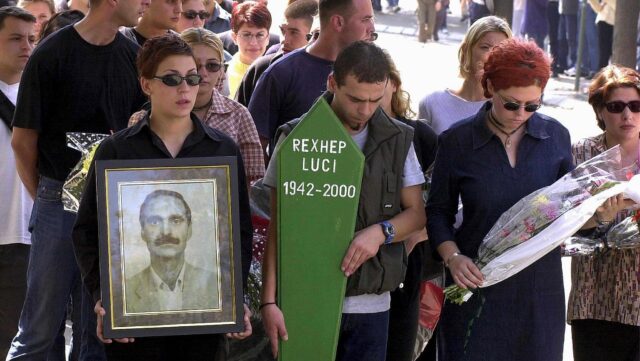
On the evening of September 11, 2000, Rexhep Luci left a meeting at the Grand Hotel in Pristina and headed home.
Luci was head of spatial planning, reconstruction and development at the municipality in the Kosovo capital, which had been flooded with people in the wake of the 1998-99 war. In 1985, Luci had spearheaded the drafting of a 15-year urban plan dubbed ‘Pristina 2000’, only to watch as Kosovo fell victim to rising Serbian nationalism and the blueprint was set aside.
That day in September, Luci had met with a group of experts to discuss temporary construction criteria for the city.
The 58-year-old had wanted a new, 20-year plan to curb the proliferation of high-rises and bring some order to Pristina’s urban development, but the United Nations officials in charge since the end of the war had cut it back to five. It was also up to Luci to order the demolition of illegal buildings.
That evening, as he approached the entrance to his home, Luci was shot six times in the back.
A quarter of a century later, his killer has yet to be identified, amid lingering suspicion that Luci’s murder was connected to his determination to rein in the unregulated construction that has since blighted the capital of Europe’s youngest state.
His colleague and close friend, architect Arber Shita, who helped draft ‘Pristina 2000’, said Luci had been anxious in the days prior to his murder.
“He seemed worried, afraid,” said Shita, now 66 years old. “I saw how his hands were shaking. But he didn’t want to talk, so I joked about it.”
“The murder was confirmation that he had indeed been warned,” he told BIRN. “The murder of the architect was the murder of the city, of the vision.”
Threatened?
Rexhep Luci. Photo courtesy of the Luci family.
Luci’s son, Lisi, saw his father for the last time a few days before he was killed, when Luci took him to the airport in Skopje and he left for the United States to continue his education.
“I was 17 years old when I left, and I didn’t know I was saying goodbye to him for the last time,” said Lisi, now 41 and living in Brussels. “When I got the news about the assassination, I had to deal with the grief in the most rational way. I had to continue my studies because I knew it meant a lot to him.”
Luci had insisted his son go abroad to study. His brother, Lisi’s uncle Kemajl Luci, remembered Lisi’s departure for the US. Luci, he said, “felt relieved only when he realised he had reached the airport”.
Kemajl believes to this day that his brother’s killer had already threatened to hurt his family, and so he packed his son off to the US as soon as he could.
It was left to Kemajl to pick up the body from the morgue. He continues to be tortured by the failure of successive administrations – UN, European Union and Kosovo’s own – to find his brother’s killer.
“I was never interviewed by any prosecutor or investigative police, nor was the family,” he said.
“Years later, I met a UN investigator who told me he was close to solving the case, but he was reassigned within the UN police,” Kemajl told BIRN. “It seems that solving the murder would have disrupted someone’s plans.”
Demolition orders
Kemajl Luci, the murdered architect’s brother. Photo: BIRN.
Luci, whose name now graces one of the main streets in Pristina, was part of the first generation of trained urbanists in Kosovo. He studied in Belgrade and returned to Kosovo, then part of socialist Yugoslavia, in 1969.
Pristina was already growing, its Ottoman-era bazaar, a mosque, Catholic church and synagogue all torn down in the service of the Yugoslav mantra – ‘destroy the old, build the new’.
Luci planned two of Pristina’s most modern neighbourhoods – Dardania and Bregu i Diellit, or Sunny Hill.
As head of the Self-Governing Community of Interest, BVI, he oversaw major construction projects in Pristina between 1978 and 1986.
Then Slobodan Milosevic rose to power in Serbia, stoking the flames of Serbian nationalism with talk of a ‘genocide’ being waged against minority Serbs in Kosovo and Croatia. In 1989, Milosevic abolished Kosovo’s autonomy within the socialist republic of Serbia and Albanians were turfed out of public institutions.
Luci was dismissed from the BVI and his house seized, forcing him to move back in with his parents.
A decade of passive resistance ensued, during which, Shita recalled, “the regime allowed nothing” in terms of construction.
Eventually, passive resistance gave way to armed struggle; Milosevic’s brutal response triggered 11 weeks of NATO air strikes, and Kosovo became a ward of the United Nations. Luci returned to work, just as Kosovo Albanians – their homes razed – poured from the countryside into Pristina in search of shelter and work.
Construction began at pace, but frequently without permits.
In 1978, Luci had told an interviewer: “Cities should reflect the soul of their people, not just the greed of their builders.”
After the war, he denounced what he called “the gangrene of illegal construction” and called for public hearings.
According to reports at the time, there were between 5,000 and 7,000 buildings under construction in Pristina, but only 30 licences had been issued.
Two days before Luci’s murder, a hotel being built illegally in Pristina’s Germia National Park was torn down on his order. A report by the NATO-led KFOR peacekeeping mission in Kosovo said he may have been murdered by “mafia” figures connected to the hotel industry.
“We had no direct indication that the murder was related to it,” Shita said. “But the fact remains that the murder happened, and it was never revealed who did it.”
Not long after the murder, UN police arrested three men, but a lack of evidence meant they were soon released. To date, no one has ever been charged with Luci’s murder.
‘Everything became chaotic’
Aerial image of Pristina from 2021. Photo: BIRN.
Luci’s son, Lisi, recalls his father as uncompromising, a man of integrity in his personal and professional life.
“He did everything as an individual, uninfluenced by politics, and without compromise in his profession,” he said.
“Since childhood, I saw how dedicated he was to regulating the urban plan of the city. Today I have the impression that many people are not aware that a proper plan for Pristina existed, on which someone worked for decades.”
“With time, I’ve come to understand, seeing the disorderly state of the city, just how much impact urban planning has on quality of life.”
The day after Luci’s murder, the UN overseer in Kosovo at the time, Frenchman Bernard Kouchner, said he “played and fought by the rules of a civil society, not the rules of gangsterism”.
As an urban planner, however, he proved irreplaceable.
“After his murder, everything became chaotic,” Shita said. Pristina was drowned in concrete as permits were issued for millions of square metres of low-quality, poorly planned building projects, safety regulations routinely ignored.
“When I hear complaints about urban congestion, traffic, pollution, or the lack of green spaces, I remind people that there is a parallel, more liveable Pristina that could have existed,” said Lisi.
Shita said he never leaves flowers at his friend’s grave on the anniversary of his death. “Every year, I send a pencil instead.”