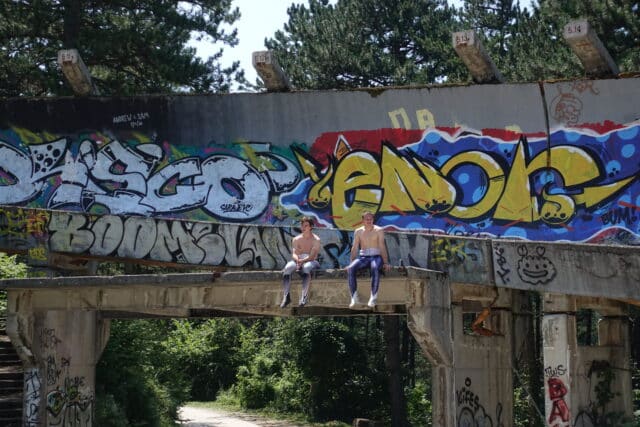
In 2016, Canadian filmmaker Ryan Sidhoo, a self-professed history lover with a deep affection for the Balkans, found himself on Mount Trebevic, overlooking the Bosnian capital, Sarajevo.
One of his many trips to Bosnia, he had sought out the abandoned bob and luge track, a relic of the 1984 Winter Olympics, when Bosnia was still part of Yugoslavia.
Winding through dense forest, the track was a testament to Yugoslav engineering and ambition. Less than a decade after the 1984 games, it was shelled during the 1992-95 war in Bosnia and Herzegovina.
As Sidhoo ascended the hill, acutely aware of the city’s bloody past, he anticipated a scene of desolation and ruin. Instead, he came across a vibrant scene: a group of boys training for luge.
Intrigued, Sidhoo quickly engaged in conversation with the young athletes and their coach.
“I was walking the track and some youngsters started yelling to get out of the track, and I thought: ‘No way, somebody is using this today,’” Sidhoo told BIRN.
It would become the focus of his latest feature-length film, The Track.
A Slovakian luge team was the first to come and use the track after the Bosnian war.
As he spoke with the boys, Sidhoo realised the track was very much alive, its spirit unyielding, despite the visible scars of destruction. “They told me they were preparing for the next Olympic games,” he recalls.
Here, amid the faded Olympic rings and bullet-pocked concrete, Sidhoo uncovered the heart of a powerful story – a place where sport, history and memory profoundly collide. This collision became the genesis of The Track.
“Then we embarked on the journey to make this story happen,” Sidhoo explains, noting that the film was shot “when the opportunity arose, and when something important with the boys was happening”.
Big ideas in a small country
Zlatan getting ready for a training session at the luge track above Sarajevo. Photo from ‘The Track’.
The film follows the story of three young athletes from Sarajevo, Mirza Nikolajev, Hamza Pleho and Zlatan Jakic who, together with their coach, Senad Omanovic, are training to compete in the 2022 winter Olympics.
Besides their ambitious goals, the documentary reflects nostalgia for former Yugoslavia times, when the country was at the centre of world attention. It depicts life in a war-ravaged country, where the funds for sports, especially those like luge, are far smaller than the ambitions of those who seek to revive it.
It is also a very personal documentary, which follows the lives of the main protagonists and their families.
Sidhoo says the hospitality of the Balkan people played a key role in making the documentary possible. “An important thing to note is that the boys and Senad co-authored the movie with me,” he says.
“I did not just go there and say: ‘This is how it’s going to be.’ We always sat down, talked about it, and had coffee with them. The most important thing was to make a movie which is hopeful, that’s uplifting,” he adds.
While the film is hopeful, it does not shy from the reality of today’s Bosnia.
According to Sidhoo, Hamaz’s story represents the generational war trauma; Zlatan’s story, the issue of brain drain from the country and the region; Mirza’s is about the resilience of the young who, despite everything, are still making their ambitions and dreams come true.
“And Senad, he saw the 1984 Olympics; he saw the glory and highs of it, and now he’s trying to bring it back to life,” Sidhoo told BIRN.
The film is also an emotional rollercoaster, showing the moments when some of them almost gave up on their dreams. It is all supported by a perfect choice of music and masterful colour grading and editing.
A ‘perfect’ ending to the story
Coach Senad fixing cracks in the track. Photo from ‘The Track’.
The Track premiered at the end of February at the True/False Film Fest in Columbia, Missouri, home to a huge Bosnian diaspora which moved there following the breakup of Yugoslavia.
“Mirza was there, and the audience went crazy. He received standing ovations which lasted several minutes,” Sidhoo shares.
In The Track, Mirza’s journey culminates in his qualification for the 2022 Beijing Winter Olympics, where he proudly carried the Bosnian flag at the opening ceremony.
During the live broadcast, his playful wink to the camera – an unplanned gesture – unexpectedly captured the attention of Chinese viewers, making him an overnight sensation there.
He trended on searches on Chinese search engines and his Instagram profile blew up overnight. In the film, he is seen excitedly talking about his fast-growing number of followers, every time he glances at his phone.
A social media following was not the only support he received. Recognising the financial hardship the coach and athletes faced in the film, The Track was selected as the recipient of True/False Film Fest’s 2025 True Life Fund, which contributed more than 20,000 US dollars to the luge team and Mirza.
The film was produced also with the support of various Canadian funds. Following the premiere, it was screened at several festivals, including the San Francisco International Film Festival and Dokufest in Kosovo, and this week at the 31st Sarajevo Film Festival.
Recalling the lengthy process of making the documentary, Sidhoo admitted he was “very excited” when Mirza Nikolajev went to Beijing, “as it was perfect for the story plot.
“I’m wondering if I would still be making this movie if he hadn’t made it to Beijing, and would I be waiting for the 2026 games,” he mused.
The 31st Sarajevo Film Festival runs until August 22, and The Track will be shown five times during the festival.