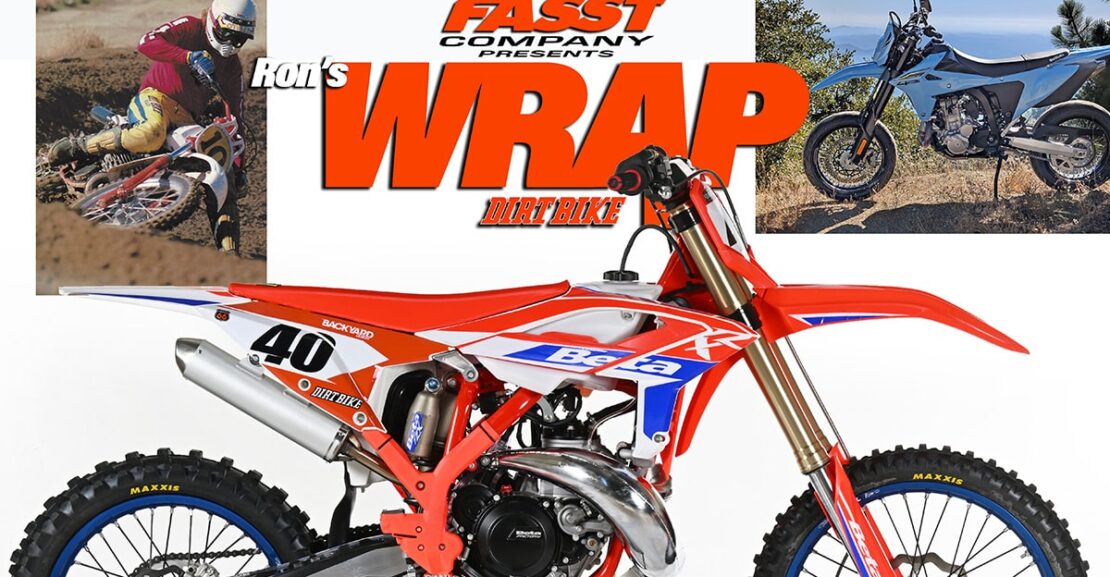
This week we got our first ride on the 2026 Beta 350RX two-stroke motocross bike. There’s been a huge buzz over this bike! Old timers see it as the second coming of the 500cc two stroke. Young pros think it might be a ready-made ticket to the Open Pro class at the Glen Helen Two-Stroke Championship. Both camps are partially right.
Beta discontinued the 300RX and launched both the 350 and a 250RX for 2026. The 350 is bored and stroked; it measures 78mm x 73.6mm whereas the 300 was 72mm by 72mm. The new 250 RX has 66.4mm bore and a 72mm stroke, so there are several cylinders and cranks in the Beta parts catalog and it will be interesting to see if they can be mixed and matched. We know that Beta was experimenting with bikes of different displacements at the Two-Stroke World Championship where they had two bikes in the top five. All the pros in that race are power hungry. The Yamahas that ran up front are always oversized, just like the Suzuki-framed KTM that Carson Brown used to defend his title. The new 350 Beta is a bike that was built with that very race in mind.
We just tested the 300RX at the end of the 2025, and the new 350 reminds us of that bike in all ways except one: power. The new 350 is a mid-range monster! Right off the bottom, the new RX is a little soft, but when it hits, it really hits. And then it revs surprisingly well for a big bike. And, make no mistake, the 350 is a big bike. It has that throaty BONG, BONG, BONG of an open-class two-stroke. That’s very different from the 300, which essentially felt like a healthy 250.
There’s no doubt that the 350 is red meat for the pro class. Vets and seniors, on the other hand, will miss the sweet powerband of the 300. That bike had a power delivery that started ramping up earlier and carried on farther. That made it much easier to ride. The 350’s power is shooter and harder hitting. We just started riding and testing the 350 and we will have more in the November, 2025 print edition of Dirt Bike.
DR-Z4SM INTRO
The week before that, we were invited to the introduction of the new Suzuki DR-Z4SM. It’s kind of a street bike, we thought. After riding it, we decided it was a dirt bike with big street bike wheels, tires and brakes. It’s the stablemate to the DR-Z4S dual-sport bike that we tested in the August issue. That bike was a very big deal to us because it was the first new Suzuki that we had tested in years. The main differences between the dual-sport version and the SM are the wheels, brakes, suspension and mapping. The SM has massive 17-inch street tires on both ends. The front brake is upped to a 310mm rotor and the suspension travel is reduced into the 10-inch range.
Suzuki arranged for us to ride the DR-Z4SM on the new K1 Circuit karting track in Winchester, California. We were the first motorcycles to ride there, and to be fair, it didn’t yet have a dedicated Supermoto track with off-road obstacles. We were strictly on the pavement, which placed us a little outside our comfort zone.
We have only dabbled in the art of sliding a motorcycle on the pavement, but we know this: it’s a blast. There were two factors that made it more difficult for us at K1 Circuit. First the pavement was so new that traction was far greater than anything we had previously experienced. The grip between the Dunlop Sportmax tires and the tarmac was unreal. On top of that, the DR-Z4SM is no race bike. The power delivery is smooth, but it has no big hit and peak output is only in the vicinity of 35 horsepower. After a while, though, it started to click. The Suzuki isn’t going to break loose from sheer power. But, with traction control and antilock turned off, it will slide coming into turns and that allows for a smooth arc all the way to the exit. The clutch has a slipper cam to reduce plate pressure during engine braking, so you could bang down shifts hard coming into turns.
The SM version and the dual-sport version of the DR-Z can exist side by side and offer an interesting choice. You can have two bikes in one with the purchase of an extra set of wheels. The question is, do you start with the dual-sport for its increased suspension travel or the SM for the larger front brake? From our brief experience with the SM, we found that most of the other differences between the two are less significant. For us, we still prefer the dual-sport, but when Supermoto comes back, wheel makers like Dubya will be our first call!
123 mph ON DIRT!
Back in 1981, the Dirt Bike staff was infatuated with the KTM 495, which was the largest, fastest motocross bike of the day. How fast was it really? They figured that stock gearing allowed around 78 mph. But how fast would it go with super tall gearing? Rod Bush, who would later become the President of KTM North America, arranged for just such a test. He installed a 15-tooth countershaft sprocket, a 44-tooth rear sprocket and the fifth gear from an enduro model. Then the DB staff took it to El Mirage dry lake where they reportedly attained 123.75mph with Rod in the saddle. The story was published in the June, 1981 issue and went viral–or at least the 1981 version of viral.
In later years, Dirt Bike tried to recreate the moment on several different occasions with more modern bikes without much luck. We found it was hard to get more than 105mph from a 500 two-stroke no matter what gearing we installed. In the January, 1992 issue, we finally broke the record with a highly modified Honda CR500R running on pure alcohol. It went 1.25 mph faster. Another major speed run attempt took place in March, 2002. We had a Honda XR650R, a Kawasaki KX500, a KTM 520 and a Husaberg 650, all modified for speed–some drastically. The Honda did 113mph, the KTM achieved 109 mph, the KX was 108mph and the Husaberg got to 104mph.
So is it true that a nearly stock bike from 1981 was faster than anything that followed? Probably not. The methodology was different each time. A stop watch was used to determine speed in 1981. In 1992 it was a radar gun and in 2002, it was via GPS. There was also a certain amount of, let’s say, charming hyperbole that was an essential part of moto-journalism 44 years ago.
See you next time!