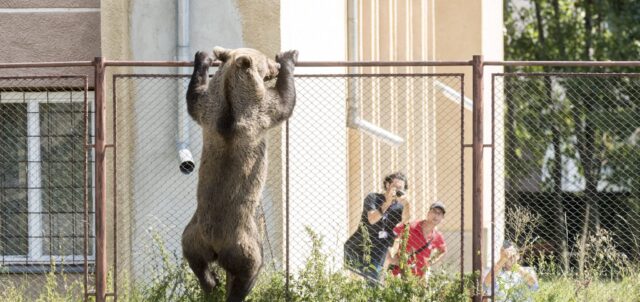
On a late March night in Predeal, the highest town in Romania, Mihai Marina, 51, was walking home with his dog after watching a football match when a bear emerged from the edge of the forest and mauled the mountain rescuer, tearing at his face and neck.
By the time he reached the hospital, Marina, who had spent 20 years saving others in the Carpathians, was fighting for his own life. His heart stopped once during the attack.
Three months later, his colleagues said Marina could now wiggle his fingers, although his voice had yet to return. He remained in the hospital, still breathing with the help of a machine.
“It’s a risk we all take,” Dana Popescu, a local entrepreneur, told BIRN. Not long after Marina’s mauling, she launched a petition addressed to the local mayor, the Romanian Environment Ministry and even the President, urging the authorities to improve preventive measures, including bear-proof trash bins as well as night patrols and cameras to monitor the town’s streets.
The people of Predeal receive emergency alerts almost daily, warning them of a nearby bear and urging them to stay inside. By August 11, the RO-ALERT system had sent residents’ phones 107 alerts this year, more than in any other town in the mountainous Brasov County. The region ranks second nationwide for reports of dangerous animals in inhabited areas, with 334 alerts issued by mid-August.
Yet, measures to keep the animals away remain scarce, with the mayor of Predeal complaining that legislation is too burdensome to cope with the large number of bears in the area, while the Environment Ministry relies on questionable data to justify its actions.
Last weekend, Environment Minister Diana Buzoianu announced on Facebook that she will put new laws up for public debate that would make it easier to kill bears that enter inhabited areas.
Afraid to go out after dark
“It will never get solved,” Popescu said. “I don’t know what tragedy must happen for someone to act.” She avoids leaving her apartment at night, she said, and if she must, she carries a flashlight. “We can’t meet our friends a street away in the evening, have a glass, and say we’ll walk home.”
On the edge of town, where Communist-era apartment blocks meet the forest, Viorica, a retiree, was trimming a fence while her grandchildren played nearby. “I tell them to stay close,” she said, pointing towards a bench a few metres away.
“I’m afraid of letting them sit there. The bear likes eating the Mirabelle plums in that tree.” When darkness falls, Viorica doesn’t go out: “That’s how it is.”
The local authorities have invested in some special waste trash containers, designed to keep bears out, but most are still the old, unprotected kind. One was knocked over, maybe by a bear, Viorica said.
Elena, an 83-year-old neighbour, said she does not bother with the new bins, anyway. The sorting system is too complicated.
She described being out for a walk when someone shouted that a bear was just ahead. She just walked back. “I wouldn’t be able to run from it,” she said. The police came and chased it off, but that doesn’t matter, Elena said. “They push them away a bit, and then they are still coming back.”
Other residents are less patient. Vasile, who was painting his fence, showed where a bear had run across his roof. “They must be shot. All those that enter people’s properties,” he said, flatly. Like many, he accuses the Environment Ministry of inaction: “What can the mayor do, without clear orders from the Ministry?”
Too many bears? Hard to say
A 2005 government report estimated that Romania’s natural habitat could sustain about 4,000 bears, from a biological as well as a social and economic point of view.
But it also said this number could change, based on “new monitoring results and future experiences in bear-human coexistence”. The report, which had no authors listed, did not explain how this figure of 4,000 was reached.
Two decades later, the new Environment Minister, Diana Buzoianu, cited the same number in an interview to claim that Romania is overwhelmed by bears. Legislation from 2018 still references the same study.
“As long as we don’t have an official document with a clear methodology and some authors who take responsibility, it means we’re talking about a document that could have been produced by anyone,” said Cristian-Remus Papp, Wildlife and Landscape National Manager at the World Wide Fund for Nature, WWF, in Romania.
In April, meanwhile, the former Environment Minister Mircea Fechet announced that DNA analysis of 24,000 samples indicated a total population of up to 12,770 bears in Romania.
But Papp is critical of the study, spanning several years since 2022, arguing that it may include animals that have since died. Such research, he said, should be done in a single season.
The maths seemed implausible to him. “At the end of such a study, one bear is usually identified in every four or five samples,” Papp said. But this study identified one bear just for every three samples. And, at the end of the analysis, there was a bear identified for every two samples.
The methodology behind the count is also not public.
Regardless of disagreements over the exact number of bears, it is widely accepted that Romania has the largest bear population in the European Union. The animals are strictly protected under European law, although after a 19-year-old hiker was killed last year, the government doubled its annual culling quota to 486 bears.
But Papp warned that these killings will do little to protect people, unless the animals being removed are the “problematic ones”, meaning the ones that find food in populated areas and cause damage.
Coexistence is still possible
A journalist for Antena 3 TV station posted a video in which Sorin Ioan Ciobanu, the mayor of Predeal, accused the media of painting a negative picture about the town. “It’s not my fault that that man was torn apart by a bear,” Ciobanu said, about the attack on Marina, the mountain rescuer.
In an interview with Radio Brasov, the mayor blamed a 2016 law banning bear hunting for the surge in bear encounters with humans.
He has also criticized an emergency law passed in 2021 that shifted responsibility in bear encounters from the Ministry to local mayors. Each town hall is required to sign contracts with intervention teams, which include specialized hunters and veterinarians authorized to tranquilize or, in extreme cases, kill the animals.
The protocol works in phases: first, chase the bear away, then tranquilize and relocate it, and only resort to shooting if the animal has then returned, or endangered the team. The mayor or vice-mayor presides over each intervention.
In 2023, Ciobanu wrote to the Romanian Senate, saying that protocol is too restrictive to keep up with the number of bears, also sending handwritten letters and emails from local residents describing bears wandering into their yards and even kitchens.
Cristina, who runs a guesthouse, described a similar incident: a bear entered her yard and broke her fence. She called the emergency services, but by the time they showed up, the bear had already left.
“Some tourists are afraid. They don’t understand what happens when you see a bear,” she said. “The locals are used to it, they know how to manage the situation.”
Still, she argued, the Environment Ministry should take stronger measures to prevent bear-human encounters.
The Environment Minister’s bill, announced on September 13, would scrap the gradual intervention approach in the case of bears wandering around populated areas; the aim is to cut through the bureaucracy and not let “paperwork put human life in danger”. The bill would also include new funding for electric fences and increased fines for feeding wild animals.
Papp believes that both local and national authorities are responsible for managing bear populations.
In Baile Tusnad, a spa town on the edge of another Carpathian valley, authorities collaborated with conservationists, including Papp, to install electric fences, cut down unprotected fruit trees, and distribute radios to rapid-response teams. Bears near the town were fitted with GPS collars, allowing wardens to track their movements. The town even opened a bear-education centre and hosts a yearly bear-themed festival.
Within two years, reported damages dropped from 41 cases to zero, and emergency alerts fell by more than 90 per cent.
Looking at Predeal, WWF expert Papp thinks the biggest problem is the poor local management of organic waste. “Bears will keep coming because they’ve got used to the food source,” he said. “Once the cubs reach these trash bins, they’ll learn from a young age that there’s an easy food source there, so it’s not worth running around the forest to hunt. It’s a vicious circle.”
Besides better waste administration, he believes educating people is essential. “Some tourists will deliberately feed the bear, so that it will come and allow them to take a photo, whether a selfie or, well, from a certain distance. This alters the bear’s behaviour,” he explained.
Papp believes these are the bears that usually make the headlines and cause debate. This summer, an Italian motorcyclist was killed by a bear on the scenic Transfagarasan mountain road. The last picture in his phone was the bear lashing at him and two cubs in the background.
“Financial investment for preventive measures can be a sensitive subject,” Papp said. “But it’s cheaper for the Romanian state than paying compensation for damages.”