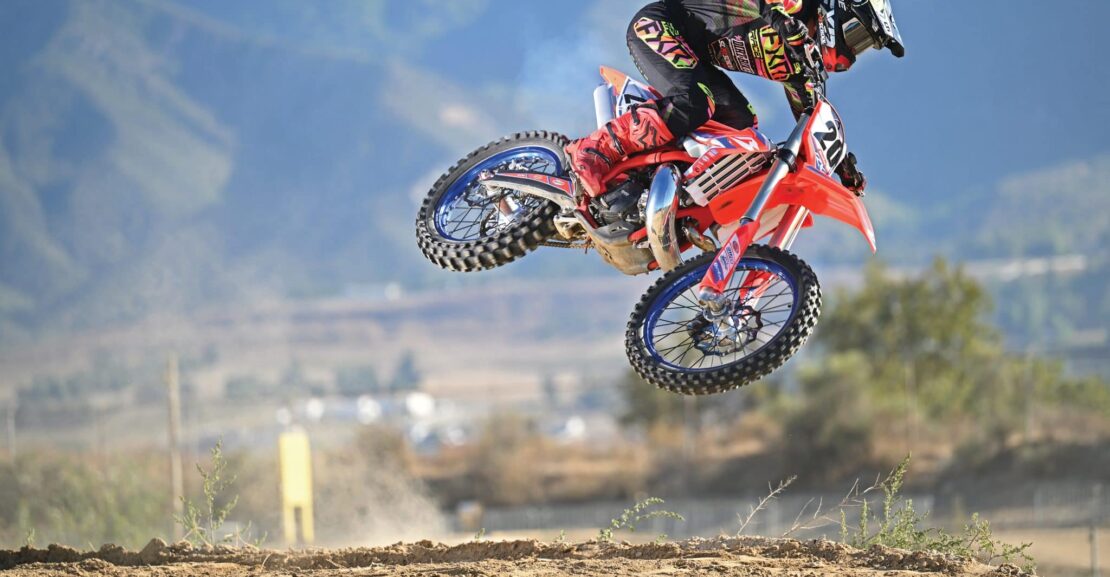
Mark down June 11, 2025, on your list of dark days that will live in infamy. That’s when it became apparent the Beta would discontinue the 300RX two-stroke motocross bike. The 300RX, if you didn’t already know, was the bike that brought Beta into the motocross world. It was first revealed in 2021, and it only got better and better from there, as it received trickle-down technology from the Liqui Moly Beta Pro Supercross team.
You can also mark that same day with big hearts and smiley-face emojis. Beta announced that two new two-stroke motocross bikes would hit America for 2026: the 350RX and the 250RX. Apparently, the 300RX was so good that it took two bikes to fill its shoes. Plus, if you read between the lines, you realize that the 300RX isn’t really gone; it’s just hiding in a parts catalog.
LAST OF ITS KIND
While all this was going down, our 2025 300RX test bike was sitting in FMF’s pipe fabrication shop being fitted for an aftermarket exhaust system. It had come to us in advance of the Glen Helen Two-Stroke Championship so that reigning champion Carson Brown could test it. At that time, he had not yet decided what he would ride to defend his title. In the end he chose the path of least resistance; he would ride the hybrid Suzuki/KTM 300 that he had used to win the event in 2024. The Beta then disappeared into the FMF pipe shop, not to be seen again until we cried so many tears that it floated back to our shop.
Now that we have it back, is there any point in even talking about it? The short answer is abso-stinkin’-lutely! The 2025 received a long list of changes that will be used as the foundation for the two new bikes. Plus, it appears that the 300 will live on in the form of the new 250RX, which was created by reducing the bore of the 300 from 72mm to 66.4mm. So, we believe the 300 is only a few parts away from living again. We will confirm when the 250RX actually arrives stateside.
To back up a little, the changes for the 2025 300RX started with the frame, which was stiffened with a larger backbone. That was a direct carryover from the 450RX motocross four-stroke. The subframe was also redesigned and fabricated from aluminum. KYB is still the supplier for the suspension components, which were updated as well. The fork is a closed-cartridge 48mm AOS unit, and the shock now has a 50mm shock body to help dissipate heat. It also got a new rear brake master cylinder with a larger capacity, similar to that of the 450. The bodywork is new, the tank is slimmer and the map switch has been moved to the crossbar pad.
In the engine department, the porting and head were updated, as well as the ignition mapping and pipe. The five-speed gearbox was redesigned as well. It still has a 72mm x 72mm bore and stroke, which has been the go-to configuration for 300 two-strokes for over 20 years. To create the new 350, by the way, both dimensions were upped to 73.6mm x 78mm.
The one factor that hasn’t changed here is critical: the Keihin carburetor is still supplying fuel mixture the old-fashioned way. That’s the bike’s chief calling card now that the KTM triplets have gone to fuel injection.
CARSON AND THE 300RX
When Carson Brown tested our Beta 300RX, he made no excuses. He needed more power. The stock Beta was no match for the highly modified KTM hybrid that he was used to. That bike looked like a Suzuki but was powered by a 2019 carbureted KTM 250SX with the optional big-bore kit installed. The reason that KTM never brought that bike to the market in the U.S. was because they feared reliability issues. His bike had been carefully mapped by Jamie at Twisted Development. Home-built KTMs of that period with the off-the-shelf 300 kit were often paired with the 250SX’s black box and mapping curve, which were never a very good match.
Carson’s decision was understandable for a pro at his level. We, on the other hand, loved the 300RX’s power delivery. Peak power is similar to that of a modern 250 four-stroke motocross bike, but it happens in a totally different place and in a totally different way. Horsepower is the product of torque and rpm. A 250F makes its power with a little bit of torque and a lot of revs. The 300RX has around 50 percent more torque and far fewer revs. So, the RX gets into the meat of its power almost instantaneously, but then drops like a stone at 9000 rpm. That, in a nutshell, is why a truly powerful two-stroke can be so hard to ride for the average Joe. Too much happens too soon. What we love about this particular 300 two-stroke is that it ramps up very controllably. Yes, it still has a ton of torque; most dynos place it around 30 pound-feet at 6000 rpm. In this case, the power climbs in such a linear fashion that you can, in fact, hold it at any level you like. It’s no toggle switch, not by any means. The bikes that win the Open Pro class at the Two-Stroke Championship are all monsters.
Back in the heyday of two-stroke dominance, none of the top bikes had a power delivery so sweet and controllable. There have been advancements in digital ignitions, as well as reed valves along the way, and that makes perfect jetting more attainable than ever before. Who knows? If we could send the 300RX back in time, things might have turned out differently for two-strokes in pro motocross.
FOUR-STROKE TRICKLE-DOWN
Beta’s Supercross program has been wildly successful on a budget-to-results basis. With resources that are a fraction of the other factory teams, they routinely placed in the top 10 with two riders on the 450RX. The 300 two-stroke benefited from the hyper-development that took place over two seasons of Pro Supercross. The frame was beefed up considerably, and the bike became more mainstream. Flipping back to the original test of the 2021 300RX, it was lovable but weird. The seat height was absurdly tall, and the ergos weren’t quite right. Now, the 300RX feels perfectly at home on a motocross course. You don’t have to adjust to any weirdness; it turns well and has excellent straight-line stability. The only remaining evidence of its off-road heritage is the softish suspension. In the front, it’s especially soft, and that makes the setup a little challenging. Just for the sake of balance, you have to run more rear suspension sag than usual—somewhere in the 108mm range. Then you have a bike that’s soft overall but perfectly rideable.
WHO AND WHERE
A stock Beta 300RX might struggle in the Pro class, but that means nothing to 90 percent of the riders in the real world. In stock form, the bike is competitive in the amateur ranks. Big four-strokes have more power, but the 300RX can nullify that disadvantage on tight tracks. It is, after all, still lighter than any 450, if only by a few pounds. On our scale, it’s 225 pounds without fuel. The on-track advantage of a two-stroke in agility is amplified by the reduction in rotational mass and correspondingly less gyro effect. In other words, it’s easy to toss from side to side.
Still, if you’re waiting for the two-stroke that can beat a modern 450 four-stroke across the board, you’ll have to keep on waiting. The 300RX is a blast to ride, it has a rich sound that speaks to your very soul, and on the right track with the right rider it can win. But, for the highest levels of motocross, Beta is hoping to open a new chapter in two-stroke history with the 350RX. Stay tuned.
BETA 300RX VERSUS KTM 300SX
Both of these bikes were meant to compete in the 2025 Glen Helen Two-Stroke Championship. The Beta 300RX was a test bike for Carson Brown, and the KTM 300SX was to be ridden by Mike Brown. For various reasons, they didn’t make it to the start line, but Carson Brown and Sean Lipanovich put them through the wringer after the event.
The numbers are pretty similar; same bore and stroke (72mm x 72mm), similar weight (221 pounds for the KTM versus 225 for the Beta) and similar price ($9599 for the KTM and $9499 for the Beta). But, they are completely different in both concept and execution. The KTM is fuel-injected with an electronic power valve that is integrated by a digital Engine Control Unit (ECU). The Beta is an old-school two-stroke with a Keihin carburetor and a mechanical power valve.
On the track, they are wildly different as well. The KTM is the clear winner in the horsepower contest. It makes more torque and revs higher. The Beta’s key strength is in power delivery and controllability. In handling, we have to say it’s a draw. Both bikes are outstanding. We will give the edge to the KTM in suspension, simply because the WP components seem more well suited to motocross, whereas the Beta betrays some of its off-road upbringing.
The quick and dirty conclusion is that the KTM is aimed more at expert-level riders, whereas the Beta will be more well suited to novices and intermediates. On top of that, the KTM demands a more intensive maintenance schedule. The Beta also engenders more appeal to the traditionalist. There’s still a great deal of mistrust when it comes to new technology in the two-stroke world, and Beta has positioned its two-stroke MX bikes as the unofficial leaders of the anti-tech underground.