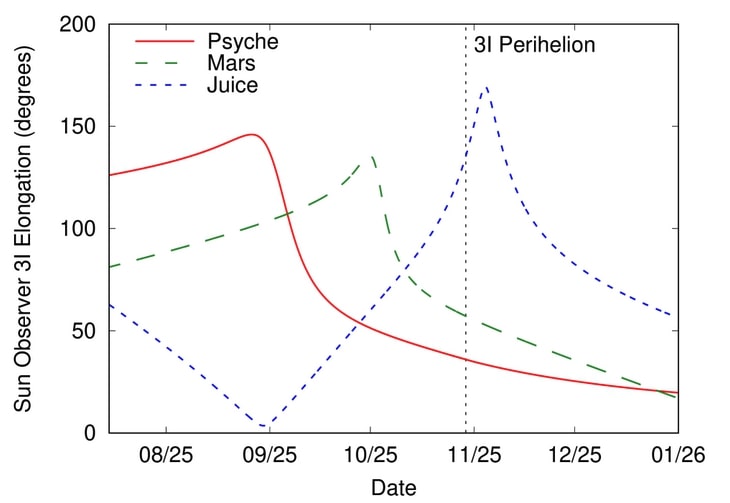
Today Psyche spacecraft on 2025 September 4 has a chance to look at 0.302 AU distance as 3I/Atlas passes by Mars.
October, the martian spacecraft array on 2025 October 3 and the Juice spacecraft on 2025 November 4.
The Europa Clipper, Hera and even the more distant Lucy spacecraft may pass through 3I’s cometary tail in the period after its perihelion passage
Three heliophysics space observatories (SOHO, Solar Orbiter and the Parker Solar Probe) will have 3I pass through their instrument’s fields of view (FOV) in this period; the Parker Solar Probe and even the solar coronagraphs may be able to monitor 3I at intervals in the period from late September through mid November in 2025. Spacecraft observations could, to the extent they are possible, provide the only source of spectral and imaging data during the 3I perihelion passage, constrain the phase angle dependence of 3I coma dust, and test the 3I thick disk origin hypothesis.
16 spacecraft in all: 11 encounter spacecraft (those targeted at other solar system planets, moons or asteroids) can conduct ad hoc observations although they are each devoted primarily to the exploration of bodies and the 5 solar observatories.
Terrestrial telescope observations will be limited at one of the most crucial times for observing 3I. Terrestrial optical telescopes, which cannot observe faint objects in daytime, will be restricted at best to observing near dawn or dusk. The Rubin / LSST, for example, has a 15° elevation angle limit, which (together with the daytime restrictions) prevents it from observing 3I from October 6 to November 14 of 2025, a 39 day period which includes both the 3I perihelion and the Juice close approach. Radio telescopes can observe during daytime but will have elongation limits. The ALMA radio telescope array, for example, has a 15° solar elongation limit; it will not be able to observe 3I between October 11 and October 30, a 19 day obscuration period which includes the 3I perihelion.
Space telescopes typically have stringent elongation limits to avoid heating or damaging the detectors. The James Webb Space Telescope (JWST) has a 85° lower elongation limit, which will prevent JWST observations of 3I from 2025 August 25 to 2025 December 09, while the Hubble Space Telescope (HST) has a 55° elongation limit, yielding a 3I blackout period from 2025 September 14 to November 23. Note that, with these limits, neither telescope will be able to observe 3I at the time of either the Mars or Juice close approaches, or the 3I perihelion.
X-ray spectroscopy can and should be attempted as X-ray observations can provide useful insight to 3I’s volatile content, searching for components such as H2, N2 and CO. X-ray telescopes also have elongation limits comparable to the large space optical telescopes, with the elongation limit for the Chandra X-ray telescope being 46.4°, and for XMM-Newton 70°. These limits corresponding to 3I blackouts of 2025 September 20 – November 19, and 2025 September 4 – December 1, respectively. These constraints will limit X-ray observations of 3I volatile production during the perihelion passage period.
Why We Want to Look at 3I/Atlas
For any potential spacecraft observations of an ad hoc target such as 3I it is necessary both to determine when observations are possible, and, if they are possible, whether they are compelling, or if they could be performed better from Earth or some other vantage point. Comets have notoriously unpredictable behavior near perihelion, and spacecraft monitoring of 3I when it is hard to observe or unobservable from Earth will be especially valuable, but observations from different vantage points, and at different wavelengths, can also provide otherwise unavailable data.
For any comet nearing perihelion, repeated observation of its light curve (the change in brightness with time), its phase curve (the change in brightness as a function of the Observer-Comet-Sun angle) and of any outbursts or fragmentation events are of scientific interest, as is regular astrometry (measurements of its position), and compositional spectroscopy. It should be possible, with the available instruments, to determine whether any rocky material is silicate or carbonaceous, to determine its water content, and the amount of any low-temperature volatiles. The available UV spectrometers should be able to sense Lyman alpha emissions from the 3I coma, which is important in constraining the total hydrogen content. Of course, as we have never encountered a thick disk object before, it is likely that it will surprise us, and so observations from a variety of instruments and viewpoints could yield unanticipated results.
An important goal of spacecraft observations near perihelion will be to observe and characterize any cometary fragmentation of 3I. The interstellar object 2I split and released a small sub-component roughly between 2020 Mar 12th and Mar 20th.
The upcoming observations of 3I offer the opportunity to test its origin chemically, and thus confirm or deny the kinematic conclusions about its origin. If 3I is from the thick disk, observations should provide insight into the star and planet-forming processes operating early in the history of our galaxy.
Thick disk ISOs should be relatively sparse compared to ISOs from the thin disk and it may be a relatively long time before another one transits the inner solar system.
Estimates imply that order 10 – 30 additional ISOs will have be found to ensure a 50% chance of finding another thick disk object, assuming that stellar systems in both disks produce on average the same numbers of ISOs per star. Even if the Rubin LSST increases the ISO discovery rate to ∼1 year-1 it could still take one or more decades before another such object is found.
Observing 3I/Atlas might be a once in a lifetime chance or maybe a 2-3 in a lifetime chance.
Maximum Brightness for the 3I/Atlas Coma Now to November 2025
If the resources are available, the coma is predicted to be brighter than 10th magnitude for at least one of these three spacecraft in the period September through November in 2025; repeated spacecraft observations during this period would be valuable if possible.
Brian Wang is a Futurist Thought Leader and a popular Science blogger with 1 million readers per month. His blog Nextbigfuture.com is ranked #1 Science News Blog. It covers many disruptive technology and trends including Space, Robotics, Artificial Intelligence, Medicine, Anti-aging Biotechnology, and Nanotechnology.
Known for identifying cutting edge technologies, he is currently a Co-Founder of a startup and fundraiser for high potential early-stage companies. He is the Head of Research for Allocations for deep technology investments and an Angel Investor at Space Angels.
A frequent speaker at corporations, he has been a TEDx speaker, a Singularity University speaker and guest at numerous interviews for radio and podcasts. He is open to public speaking and advising engagements.